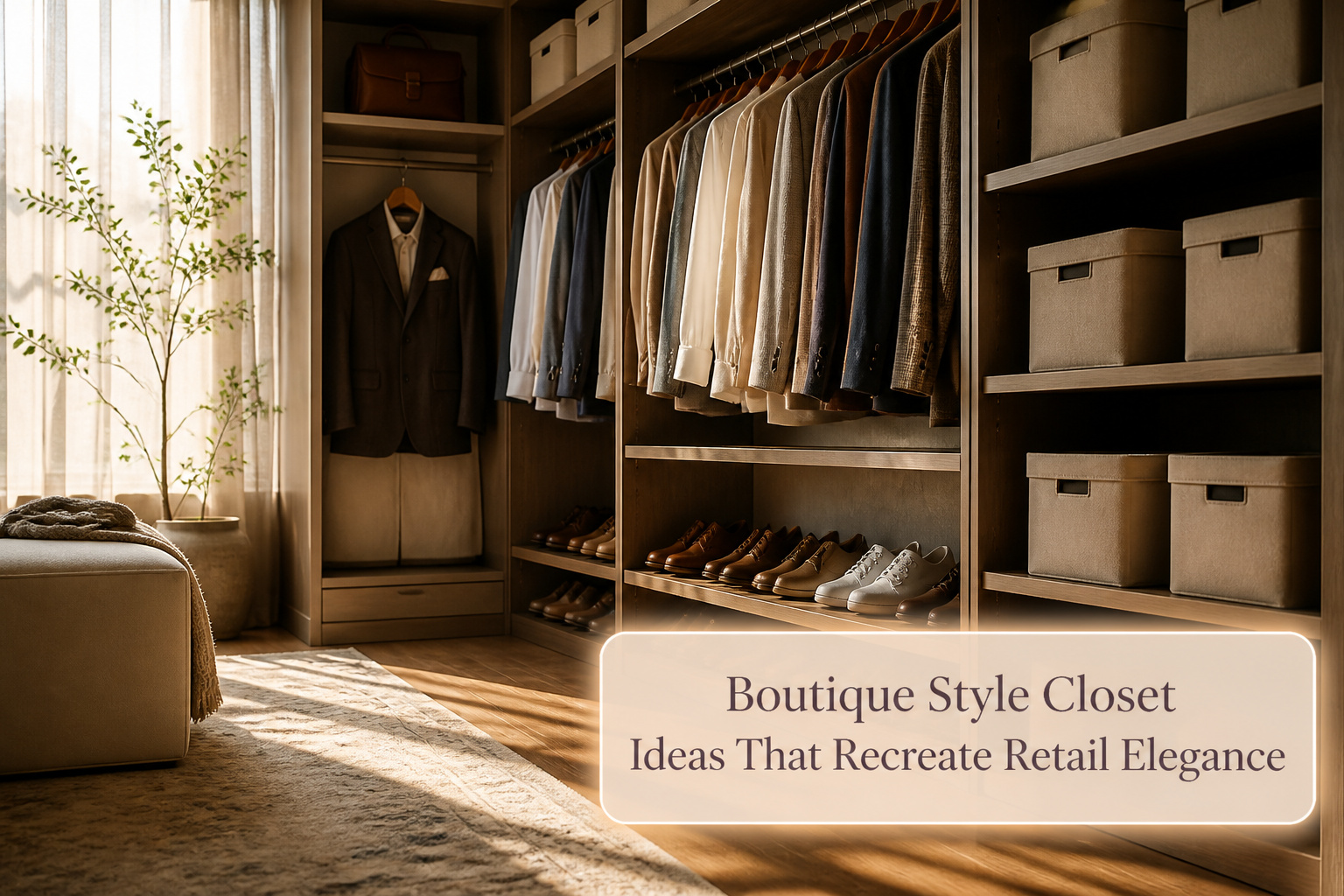
The boutique effect in a closet comes down to breathing room, not budget. A rod at eighty percent capacity reads like a shop floor; a packed one reads like storage no matter what the hangers cost. I proved that with a $15.29 pack of velvet hangers from Walmart, which halved the thickness of my old plastic set and turned a mismatched rail into one continuous surface. The catch is the editing habit that keeps it that way: everything you own has to earn its place in the open, or the look collapses in a week.
1. Uniform Hangers

Slim velvet hangers do more than look tidy; they physically change how much clothing fits in the same rod length. I swapped out a mismatched collection of wire and plastic hangers last spring, and the difference in visual density was immediate. Where my eye used to catch on every odd shape and color, the row now reads as one continuous surface, the way merchandise hangs in a small retail shop.
The velvet surface keeps silk blouses and wide-neck tops from sliding onto the floor, which was the problem that pushed me to finally buy in. I paid $15.29 for a 20-pack at Walmart, enough to test the look before committing the whole closet. At that price, a full wardrobe runs under $80 if you need roughly a hundred hangers, though most people can phase the swap over two or three months and spread the cost.
Velvet hangers save roughly half the thickness of standard plastic, which matters most in a narrow reach-in where every inch of rod space competes. The slim profile also means garments hang closer to true vertical, so pants and skirts fall straighter and need less re-hanging after you brush past.
Recommended Products

INCLUDES: 50 suit clothes hangers in Navy Blue/Silver for keeping shirts, blazers, slacks, and more neatly hung and organized

PACK: These 25 packs of kids sized hangers are perfect for shirts, pants, dresses, and more.

INCLUDES: 50 suit clothes hangers in Navy Blue/Rose Gold for keeping shirts, blazers, slacks, and more neatly hung and organized
2. Color and Style Grouping

Boutique racks read like a gradient because every piece is sorted by color, not by category. I tried that first. Neutrals flowed into jewel tones, then brights, and for about a week the closet looked like a shop floor. The problem hit when I pulled a floral blouse that pulled in three colors and a striped dress that hit four. Neither had a single home. They kept migrating to the wrong end of the rod, breaking the line I’d built.
The fix was adding a style lane for prints and patterns, parked between color blocks so the eye still travels in order. Solids stay in their spectrum; anything multicolor lives by type, floral with floral, stripe with stripe. It keeps the boutique feel without forcing a rainbow shirt to choose one shade. Huggable hangers help here too, since their slim profile keeps even a busy section looking tight and intentional.
Recommended Products
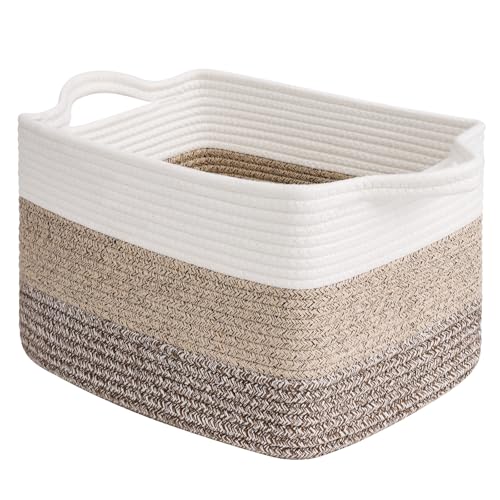
Soft Material: The shelf organizer basket is made of cotton rope. Our rope basket soft yet sturdy enough to stand up on their own and the bottom will never collapse

HANGING CLOSET ORGANIZER - Improve your closet organization with open shelving that provides great accessibility and visibility, organizer maximizes utilization of vertical space, makes it perfect for small closets.

Premium Fabric: The storage bins are made of stiff cardboard on the bottom and all sides walls so that the organization bins stand on their own, even when empty; sturdy materials ensure that these storage containers are strong and long-lasting
3. Thoughtful Lighting

The builder-grade flush mount in my closet, the kind every apartment seems to come with, did nothing for the space except cast a flat, yellowish light that made navy and black indistinguishable. Swapping it for a statement overhead fixture, something with a little sculptural presence, changed the whole feel before I touched a single shelf.
For the layers underneath, a motion-sensor LED strip cost me about $25 and twenty minutes with the adhesive backing. A hardwired integrated system would have run closer to $200 plus electrician time, and as a renter that was never on the table. The rechargeable strip wakes up when I open the door, gives a clean even glow across the hanging rods, and has survived two years of daily use on a single charge cycle every few months.
Backlit mirrors came up in every boutique closet I studied, but the vanity zone was a luxury my square footage couldn’t fit. Where I did land was a small battery-operated puck light inside a display shelf for the three bags I actually rotate; it draws the eye the way accent lighting does in retail without the wiring. The overhead fixture handles the drama, the strips handle the work of seeing what you own, and the gap between what I spent and what I bypassed is money still available for the things the light is falling on.
Recommended Products

Sew Cute

Closet case Charlie caftan pattern

4. Accessory Displays

Open shelving and glass-front cabinets turn accessories into the main event, the same way a boutique puts its best pieces where you see them first. Shoes line up like inventory, bags sit at eye level, and jewelry trays keep small pieces from disappearing into drawers.
The dust issue on open shoe shelves is real, and nobody warned me until white sneakers started looking beige. A compromise that works: open cubbies for the three or four pairs in current rotation, with the rest behind a door or in a drawer. Glass-front cabinets give you the display effect without the same maintenance, though you will still wipe smudges.
Boutiques keep backstock out of sight, and the same rule applies at home. Off-season pieces, duplicates, and anything you have not worn in a year belong in closed storage. If it never earns its way onto the open shelf, it is probably ready to leave permanently.
Recommended Products

Fresh elegant design: Experience the enduring sensibility of the Inspire collection’s two-light flush mount ideal for any hallway, foyer, bedroom, or bathroom in transitional settings

Unique Design: Tired of the common ceiling light? this is the one you need to own! This semi flush mount ceiling light fixture can cast a beautiful shadow on the ceiling when it's on

BRIGHTEN ANY INDOOR SPACE: This Designers Fountain 9-inch flush mount ceiling light features a durable steel frame and frosted white glass shade in a clean white finish that blends with any décor
5. Personal Vignettes

A vignette in a real closet is not the styled photo where a ceramic hand holds a single pearl earring. In my closet, it is a silver tray on the shelf that corrals my late dog Sasha’s framed photo, a Wedgwood bowl for loose change, and the extra pair of reading glasses I would otherwise hunt for every morning. The tray groups them so the eye reads one intentional moment instead of three random objects.
A tray is the simplest way to fake curation when you own normal things rather than prop-department accessories. My second vignette is just two style books stacked flat, a bag that was too pretty to store in its dust cover, and a shoe box I kept because the pattern deserved display. That is all. No fresh flowers, no museum lighting. The books add height, the bag adds color, and the box adds texture without asking for maintenance.
The pieces that earn the spot are the ones you actually reach for or smile at. My reading glasses live there because I use them; Sasha’s photo lives there because I want to. If an item does not serve a daily function or carry genuine meaning, it becomes clutter dressed in sentiment. Two vignettes is my limit in a closet under a hundred square feet. More than that and the boutique effect tips back into storage chaos, which defeats the point of opening the door to something that feels like yours.
Recommended Products

INCLUDES: 30 suit clothes hangers in Ivory/Silver for keeping shirts, blazers, slacks, and more neatly hung and organized

INCLUDES: 50 suit clothes hangers in Black/Rose Gold for keeping shirts, blazers, slacks, and more neatly hung and organized

Heavy Duty Load Capacity: Thickened ABS plastic; each hanger holds up to 30 lbs; supports winter coats, denim, sweaters, hoodies and shirts without bending, warping or cracking; wrinkle-free
6. A Seating Spot

A bench or ottoman turns a closet from a storage corridor into a room you actually want to step inside. The sources I read kept circling back to this, and the piece that convinced me was the round velvet ottoman with hidden storage: somewhere to sit for shoes, a landing spot for folded laundry, and a place to stash off-season scarves out of sight.
The catch is clearance. You need 24–30 inches of walkway space between parallel runs to move comfortably, and that is exactly where my own closet fell short. It technically qualified as walk-in, but barely. I had about 28 inches at the narrowest point. A fixed bench would have turned every morning into a sideways shuffle. The wall-mounted accessory racks and pull-out hampers the same sources suggested would have kept the floor open, yet they did not solve the seating problem.
What worked instead was a low ottoman, 14 inches high, that tucked under a shallow shelf when not in use. It gave me the perch without stealing the walk space. Two ways to play this: if your aisle hits that 30-inch mark or better, a fixed upholstered bench with storage underneath feels settled and intentional. Under 24 inches, skip the seat entirely and put the luxury budget into a plush rug or a small tray for perfume bottles. Between those numbers, the tuck-away piece wins.
Recommended Products

INCLUDES: 30 suit clothes hangers in Black/Silver for keeping shirts, blazers, slacks, and more neatly hung and organized

PREMIUM QUALITY SPACE SAVING SLIM HANGERS: The ultra-thin design with an optimal size of 21x0.2x10 inches wide for extra-large shirts or clothing hangers maximizes the storage space and makes full use of your wardrobe and room to make it clutter-free. Increases closet space by up to 50 percent. A galvanized metal hook with a 360-degree meets your different hanging angle needs, good for easy clothing sorting, a perfect combination.

33 PACK NAVY BLUE VELVET HANGERS — The right count for a new space and still three more than a 30-pack. Each navy blue velvet hanger measures 17.5" wide with a slim 0.24" profile and 360° swivel hook, sized perfectly for adult shirts, dresses, suits, and coats. Velvet clothes hangers for apartments, dorms and every first wardrobe that deserves better than wire. 33 hangers. Everyone else sells 30. Three extra, because you'll need them.
7. Decorative Storage

Clear shoe boxes from The Container Store have held up through every closet redo I’ve read about, and the logic tracks: you see what you own, so you wear it. For handbags that need dust protection, the same clear display boxes keep bags visible without the boutique price of built-in glass shelving. Belts and ties hang best when grouped with the suits they match, which is exactly how retail arranges them.
Baskets with structure matter more than the material. The Montauk Bins pair with gold bin clips that double as labels, and that hardware detail ties directly into the closet’s existing finishes. A bin that collapses after six months wastes the organizing time you already spent, which is why I skip the fabric cubes sold in seasonal aisle displays. Hat walls using simple hooks turn storage into a statement piece, though hat stands or mannequin heads work if wall space is tight.
Recommended Products
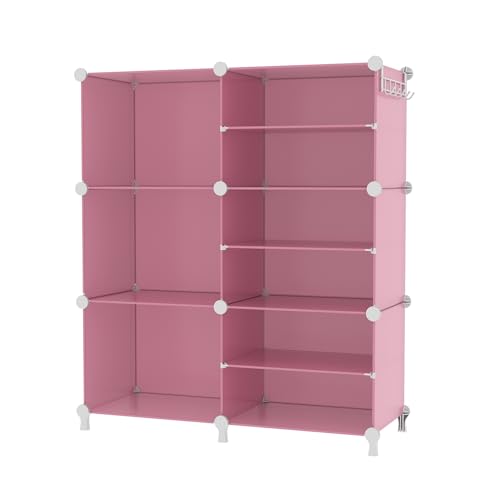
Portable Closet: You can build this cube storage shelves how you want and stack in a combination of different configurations to fit in different area. Compared to traditional wooden cabinets,it is light enough to move around

High Quality Storage Cubes: 3 packs cube storage bin made of high quality cotton material, firm enough, stylish enough, soft without sharp edges, not scratching the floor or furniture,suitable for children, elder and pets, can be used anywhere in the home. Our cube storage organizer are hand-woven and sturdy, ensuring years of use

【Basket Organizer】The size of woven rope basket is 13.7 * 9.5 * 6.3 Inches.One basket can hold 14-17 books, 6-8 pairs of pants, thin blankets, clothes, towels, snacks, baby toys, pet supplies and more. This set contains 3 baskets, providing ample capacity to organize your items.
8. Full-Length Mirrors

A full-length mirror makes a small closet feel significantly larger, and after trying both placements, the spot that actually gets used matters more than the one that photographs best. I first leaned a tall mirror against the back wall where the light hit it perfectly for pictures. Looked great, but I had to walk across the closet to see my shoes with my outfit, so I rarely did.
The overdoor full-length mirror from Wayfair solved that. Hooks over the back of the closet door, takes zero floor space, and sits right where you change. It cost less than my first attempt and gets used daily. If you have the wall space, a second mirror on the opposite wall at an angle gives you that rear view for fit checks, but the door mount is the move for tight spaces.
9. Clutter Editing

A boutique closet falls apart the moment the rod gets crowded. I edit mine on a schedule: every change of season, everything comes out and faces judgment. The pieces that pass go back by zone, dresses with dresses, shirts with shirts, the system the closet was built around. What fails does not go straight to donation. That was my old method, and it only meant I re-bought half of it later.
The rejects live in a bin under the bed for six weeks. If I do not retrieve something, it leaves for good. That waiting period cuts the regret purchases almost to zero. The closet stays at roughly eighty percent capacity, which leaves the hangers breathing room and the eye a clear path through what remains. The boutique effect is not the volume of clothes; it is the space between them.
Recommended Products

Elegant Modern Look: This ceiling light fixture features a metal frame with crystal accents that create beautiful light patterns across the ceiling when illuminated. The open-bottom design puts out plenty of light while making bulb replacement quick
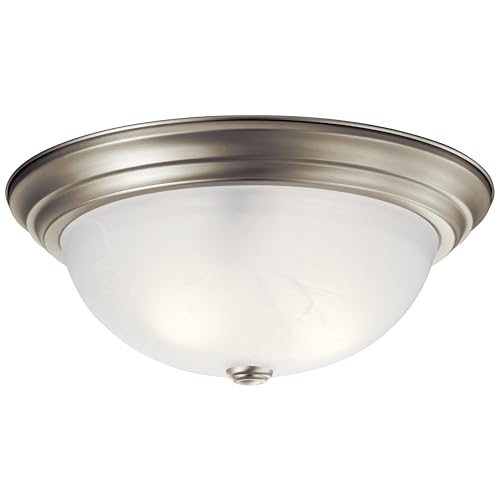
Design: Luxurious flush mount ceiling light fixture featuring clear satin etched glass and brushed nickel finish, perfect for bedroom ceiling light, kitchen ceiling light, or living room ceiling light applications to transform spaces

【High Performance】 semi flush ceiling lights(Glass Shade Diameter: 9.45'', Canopy Diameter: 4.72'' , Lamp Height: 8.07'') featuring unique clear glass shade and vintage style matte black metal base, bringing a modern twist to its Avant-garde retro design
10. Quality Finishes

The finishes in a boutique closet are where the $30,000–$250,000 luxury range and a weekend project split apart, or at least that is what I assumed until I tried the cheaper path. Brass hardware, soft-close drawer slides, and a consistent palette of two or three colors read as custom even when the carcasses behind them are basic builder-grade. I spent roughly $200 on pulls and knobs, another $60 on a gallon of high-gloss cabinet paint in a warm off-white, and the closet suddenly felt intentional in a way the rest of the bedroom did not yet match.
"For a boutique-style closet that includes elements like hidden safes, rotating shoe racks and high-tech features, you could expect to invest anywhere between $50,000 to $100,000."
That gap between fifty thousand and a few hundred dollars is exactly where most of us live, and the trick is concentrating the money on touchpoints. Velvet hangers in bulk, matching finishes on every visible surface, and soft-close hardware on at least one drawer so the first pull feels expensive even if the second is standard. The paint matters more than the wood species underneath; high-gloss lacquer or a convincing enamel over MDF bounces light around a small walk-in the way marble might in a larger one. I skipped the glass doors and the brass trim, and I do not miss them. What reads as luxury is consistency: every handle the same, every edge painted, every drawer sliding shut with weight rather than rattle.
Recommended Products

INCLUDES: 50 suit clothes hangers in Black/Silver for keeping shirts, blazers, slacks, and more neatly hung and organized

INCLUDES: 50 suit clothes hangers in Ivory/Silver for keeping shirts, blazers, slacks, and more neatly hung and organized

INCLUDES: 24 skirt hangers in Black for keeping skirts, slacks, jeans, shirts, jackets, and more neatly hung and organized
Smart Upgrades That Actually Matter

Motion-activated LED strips were the first smart addition I tried, and they stuck. The lights come on when I open the closet door, off when I close it, and I never have to hunt for the switch with an armful of hangers. Battery-powered puck lights with a remote were cheaper, but the remote always wandered off, so I ended up back at the motion sensor. Built-in speakers came up in a couple of boutique closet builds I read through, and I almost ordered a Bluetooth mirror cabinet before I caught myself. I do not get dressed to music. I get dressed to coffee and quiet. Speakers would have solved a problem I do not have, and the wiring would have eaten a Saturday I needed for actual storage fixes. The one upgrade I regret skipping was a small dehumidifier rod. It costs about the same as two months of those moisture absorber tubs, runs silently, and keeps leather bags from smelling like a basement by August.
Seasonal Rotation Without a Spare Room
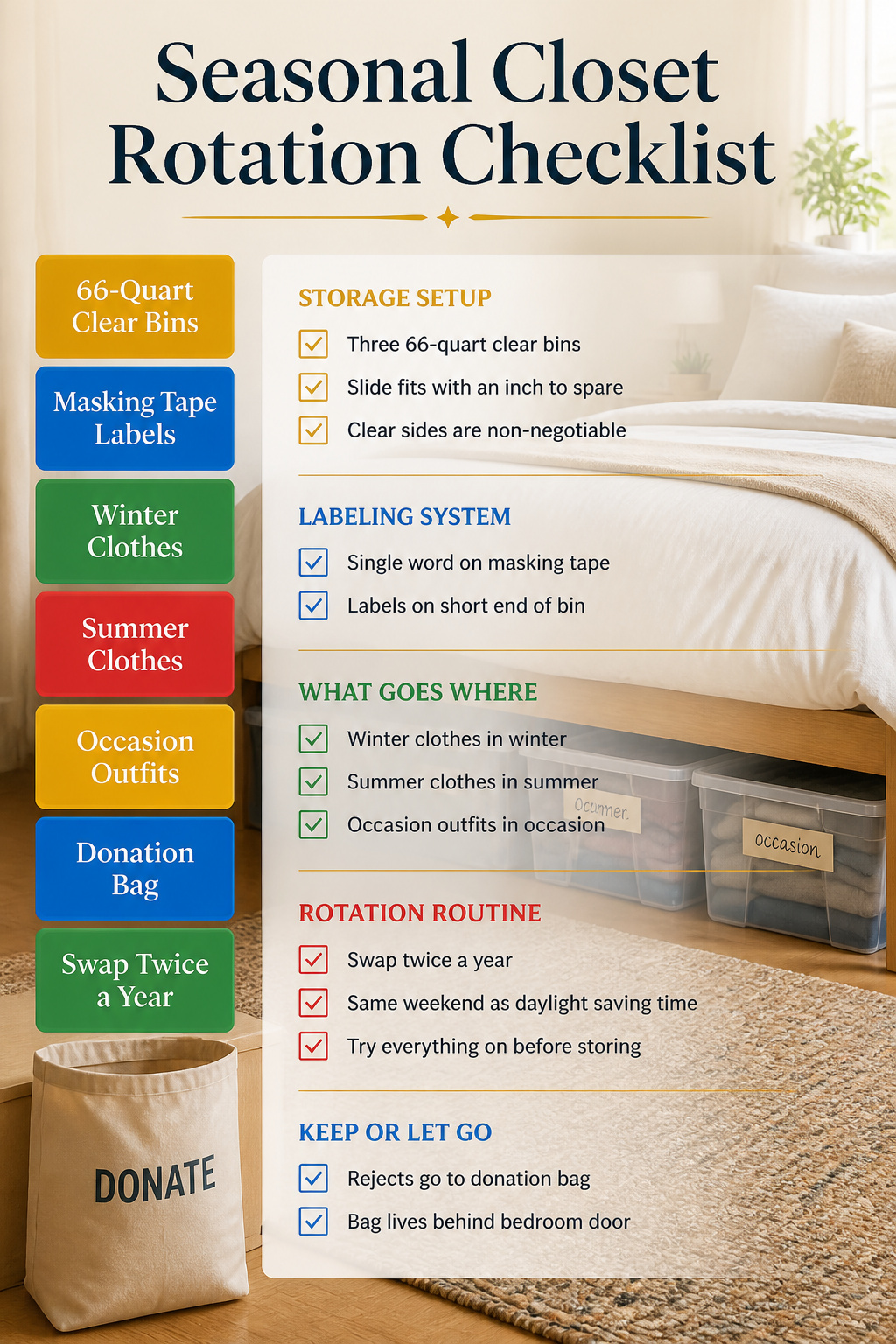
The bed frame in my one-bedroom apartment sits high enough that three 66-quart clear bins slide underneath with an inch to spare, and that gap is where my off-season clothes live. I learned the hard way that opaque storage means forgotten pieces, so the clear sides are non-negotiable. Each bin gets a single word of masking tape on the short end: "winter," "summer," "occasion." No dates, no subcategories. The system only works because I do the swap twice a year, same weekend as daylight saving time, which is the one calendar cue I never miss.
Rolling the bins out takes ten minutes. What takes the afternoon is trying everything on before it goes back in, because a boutique-style closet only earns the name if what hangs there is actually wearable. The rejects go straight to a donation bag that lives behind the bedroom door until full. Last spring I found a blazer I’d shoved into "summer" three years running, still tagged. That bin got relabeled "tailored," which finally forced me to wear it or lose it.
What Boutique Style Actually Means

A boutique-style closet is not the same thing as an organized closet, though the two overlap. Organization keeps chaos at bay; boutique style adds the feeling that every item was placed there on purpose, for you. The difference shows up in three places: what you see, how it moves, and what the space makes you feel when you step inside.
What you see is display, not mere storage. Open shelving turns shoes and bags into a gallery. Favorite pieces hang in full view rather than vanishing into a packed rod. The arrangement follows your eye, not just your inventory, so a morning browse becomes something closer to shopping your own collection.
How it moves matters too. Boutiques separate zones by category so the flow feels calm, not like a hunt through overstuffed racks. Each section has breathing room. The goal is an effortless selection process, not a battle with clutter.
The mood layer is where personality lands. Lighting, small décor touches, and finishes create an atmosphere: luxurious, relaxing, joyful, whatever you need the space to hold. A boutique closet is a destination, not a pit stop. Getting dressed becomes a pleasure, and winding down there at night feels natural.
Storage Solutions That Hold Their Shape

Pull-out trays and shoe cubbies look polished on day one, but the real test is whether they still slide straight after six months of use. I learned this the hard way with a set of acrylic jewelry trays that warped just enough to catch on their tracks, turning a smooth morning routine into a daily tug-of-war. The velvet-lined trays that hold their shape cost more upfront, but they stay flat and quiet where the bargain versions eventually bow.
Shoe cubbies tell the same story. I have seen slanted shelves sag under the weight of leather boots and watched wire racks dent where heels pressed in. The clear shoe boxes from The Container Store run about $30 for a hanging organizer or closer to $195 for a 360-degree rotating tower, and both keep their form longer than open cubbies that leave shoes exposed to dust and the occasional bump from a vacuum hose.
For belts and ties, a hanging organizer mounted near your suiting section keeps the retail logic intact: categories together, everything visible at a glance. I skip the over-door hooks for anything heavier than a silk scarf; the adhesive fails in humid months, and finding your organizers on the floor at 7 a.m. is not the boutique experience anyone wants.
Frequently Asked Questions
What are some ideas for organizing a boutique-style closet?
Start with uniform velvet hangers, which save roughly half the thickness of plastic ones and let garments hang straighter. Sort by color for solids, but give prints their own style lane so nothing breaks the visual flow. Add open shelving for shoes and bags, keep off-season pieces in closed storage, and leave rods at about eighty percent capacity so pieces have breathing room.
How can I make my closet feel more luxurious?
Concentrate spending on touchpoints you touch and see daily: matching hardware on every drawer, soft-close slides on at least one drawer so the first pull feels expensive, and high-gloss paint over existing surfaces to bounce light. A statement overhead fixture plus motion-sensor LED strips underneath creates layers of light without hardwiring. Small vignettes, like a tray grouping meaningful objects, add personality without clutter.
What lighting is best for a boutique closet?
Use a statement overhead fixture for drama and motion-sensor LED strips for functional, even glow across hanging rods; the author spent about $25 and twenty minutes installing adhesive-backed strips. Battery-operated puck lights inside display shelves draw the eye to featured accessories. Skip backlit mirrors unless you have vanity space; the layered approach of overhead plus task lighting works in closets of any size.