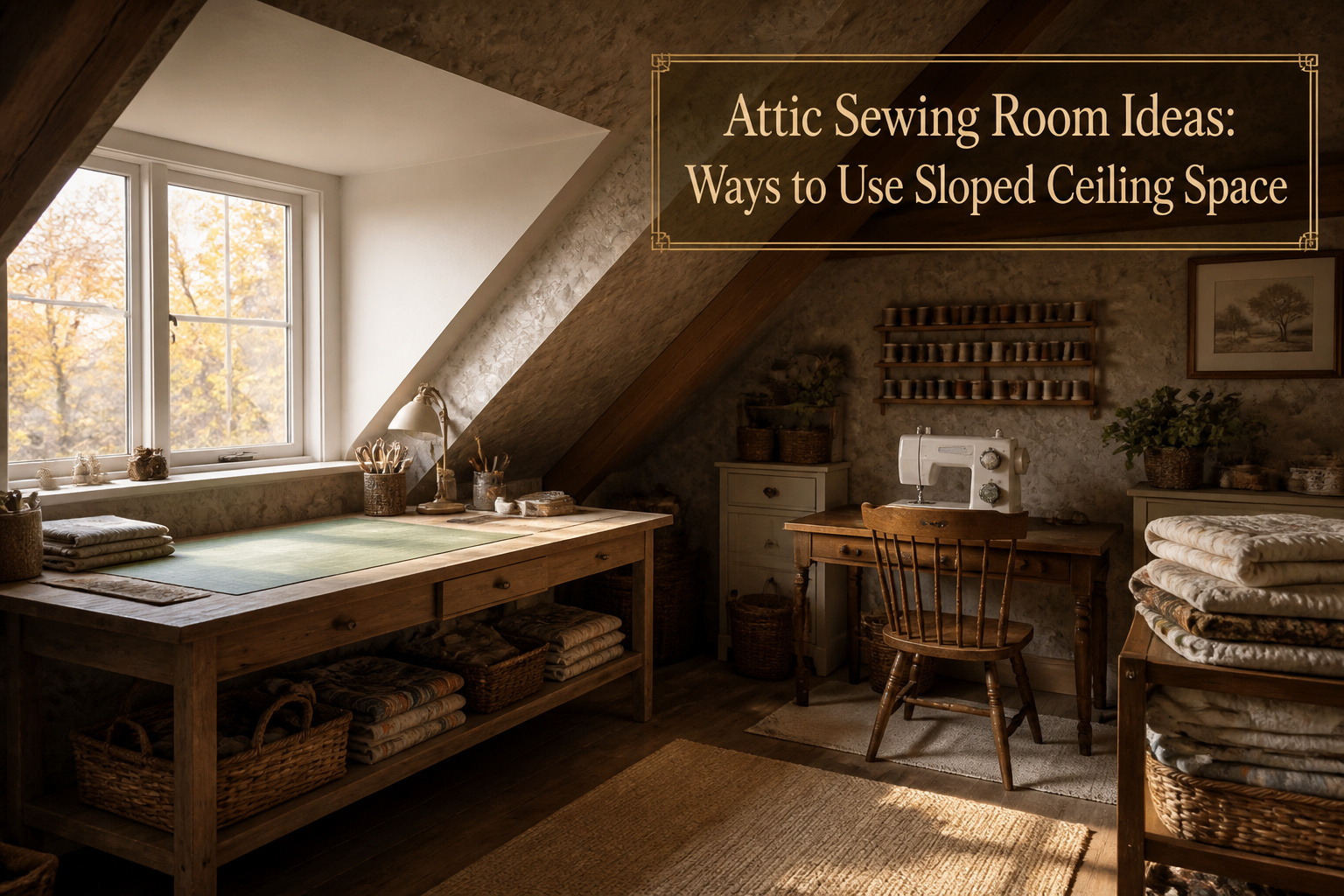
An attic sewing room is a workspace carved from the triangular void under a roof, and the sloped ceilings that make it charming are the same angles that swallow your usable wall space before you bring in furniture. The 14 x 16 foot footprint typical of these rooms leaves no floor area to waste, which is why a dormer window built into the slope matters more than a vertical one would: it becomes a full light source without sacrificing the space where your cutting table needs to sit. Position the machine to face that window directly, and the ceiling above becomes irrelevant.
1. Natural Light Sources

Dormer windows and skylights turn an attic sewing room from a cave into a workspace you actually want to spend a Saturday in. The light matters for more than mood: matching thread colors under a yellow bulb at 9 p.m. is how a navy zipper ends up on charcoal fabric, and process shots of finished projects look flat and chalky without enough natural fill.
In a 14 x 16 foot attic room with slanted ceilings and inset walls, the angles eat your usable wall space before you even bring in furniture. A dormer window built into one of those slopes becomes a full light source without sacrificing the floor area a vertical window would demand. Position the machine table to face it directly, the way you would a desk, and the slanted ceiling above becomes a non-issue.
Skylights above the work area do something similar from overhead, though they scatter light more evenly across cutting surfaces. Either setup gives you enough daylight to sew accurate seams and photograph finished work without a ring light, which is the difference between a room that functions and one that frustrates.
Recommended Products

Enhance Natural Light and Well-being: Our skylight window is designed to flood your space with natural sunlight, improving mood and health. for inclined roof skylights and horizontal roof skylights, it transforms dark areas into vibr-ant living spaces.

SHED LIGHT ON YOUR RV’S LIVING SPACE | Smoked Skylight Window Cover Transforms the Look & Feel of Your Camper by Filtering in the Perfect Amount of Natural Sunlight | Universal Size Fits Most RVs, Motorhomes, Travel Trailers & Similar Recreational Vehicles | Dimensions: 18” x 26” [Flange] & 14” x 22” x 4” [Dome Measurements]
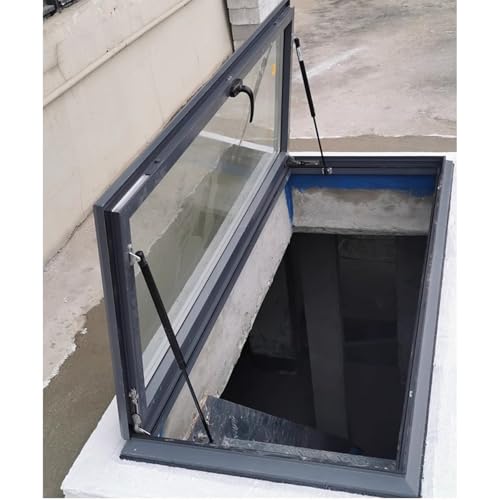
Aluminum Alloy : Aluminum alloy bezel, edge with seamless welding technology, no leakage phenomenon. Aluminum borders are not afraid of sun and hail, long service life
2. Storage Solutions

Vertical space in an attic sewing room is non-negotiable, since the knee walls swallow most of your floor area before you even bring in furniture. The IKEA Kallax 5×5 organizer sits flat against a short wall and turns that dead zone into sixteen cubbies of usable storage, plus the top surface for a pressing station or extra cutting mat. I have seen these units hold entire fabric stashes with room left for the machine itself.
For the fabric that goes inside those cubbies, comic book boards beat expensive fabric-store alternatives at a fraction of the cost. You fold yardage to the height of the board, wrap it around, and suddenly every piece stands upright at identical dimensions. No more toppling stacks or buried prints you forgot you owned.
Pegboard fills the gaps the Kallax cannot reach. A standard IKEA panel mounted on the sloped ceiling above your table keeps rulers, rotary cutters, and shears in arm’s reach without consuming a single inch of counter space. Small white bins on the shelves catch crumb scraps and thread spools; clear containers for threads and small items let you scan inventory in one glance instead of opening six lids. The whole system costs under a few hundred dollars and installs in a weekend, which matters when your sewing time is already borrowed from other obligations.
Recommended Products

Proudly manufactured by a small, family business in Penssylvania USA. Compatible with 1/4" pegboards. Each hook holds 1 thread, and 1 bobbin each.
3. Multi-Functional Furniture

A cutting table that doubles as storage is the single most useful piece in an attic sewing room, and the size matters more than the finish. Mine is 5 by 8 feet, which sounds excessive until you try laying out 60-inch fabric for a single-layer cut. That footprint fits the largest rotary cutting mat available without overhang, and it makes matching plaids or prints far less tedious than working in sections. The height works for standing work, which matters when sloped ceilings eat the wall space where a seated desk would sit.
Kitchen islands convert well to this purpose. One blogger had a Rhino cutting mat custom-cut to fit hers, turning a piece meant for meal prep into a sewing station with a durable, self-healing surface. Casters underneath let her roll it to where the ceiling height allows movement, then park it under the slope when floor space gets tight.
Drawers sized for pattern envelopes keep the top clear, and open shelving below handles rolls of interfacing or paper. A 6-inch PVC drain pipe hung from the underside of a shelf, suspended off the lower surface, keeps 60-inch interfacing rolls from unspooling across the floor. The same pipe trick works for vinyl backdrops if you shoot photos of finished quilts.
Versatility is not a bonus in these rooms; it is the only way the space functions. What serves as a cutting surface today might need to become a photo station tomorrow, or slide aside so a toddler can build block towers on the floor.
Recommended Products

Sporting happy graphics any quilter can stand behind, it is fun and functional
Sporting happy graphics any quilter can stand behind, it is fun and functional

SKADIS PEGBOARD COMPATIBLE: Designed specifically to mount onto the Skadis pegboard, keeping your sewing rulers organized and within easy reach.
4. Organization Tips

Fabric storage in an attic sewing room lives or dies on whether you can see what you have without unfolding half a shelf. Comic book boards changed how I handle this. You fold fabric to the height of the board, wrap it around once, and suddenly every piece stands upright at the same width. The boards cost a fraction of what specialty fabric shops charge for branded bolt boards, and the uniform size means a 5×5 cube organizer becomes a filing cabinet for color or weight instead of a jumbled stack.
Pegboard on the knee wall or a flat gable end handles tools and notions that otherwise migrate into drawers and stay lost. Hooks hold scissors and rotary cutters; small baskets balance on the pegs for bobbins, binding clips, and marking tools. You can buy pegboard ready-made or build your own with a simple frame and furring strips.
Clear bins look tidy on day one, but after six months the ones that stay useful have labels facing the sloped ceiling side, where your eyes actually go when you duck under a rafter. Fabric folded on boards and stored vertically keeps its identity visible. Tools on pegboard stay in the open air where use returns them to place. Everything else drifts toward the chaos it came from.
Recommended Products

TRUE 12x12 STORAGE CUBES FOR CUBE SHELVES – Each Clutter Mutter fabric storage cube measures 12 x 12 x 12 inches, giving you a roomy fit for cube organizers, cubby shelves, closet shelves, dorm storage, nursery shelves and open bookcases. Please measure your shelf opening before purchase for the best fit.

Durable & Stable: Made with durable, dust-resistant, and tear-resistant non-woven fabric, our fabric storage bins offers long-lasting durability for daily use while adding a touch of style. Mix and match to add a personal touch to your space.

Durable & Stable: Made with durable, dust-resistant, and tear-resistant non-woven fabric, our fabric storage bins offers long-lasting durability for daily use while adding a touch of style. Mix and match to add a personal touch to your space.
5. Decor Ideas
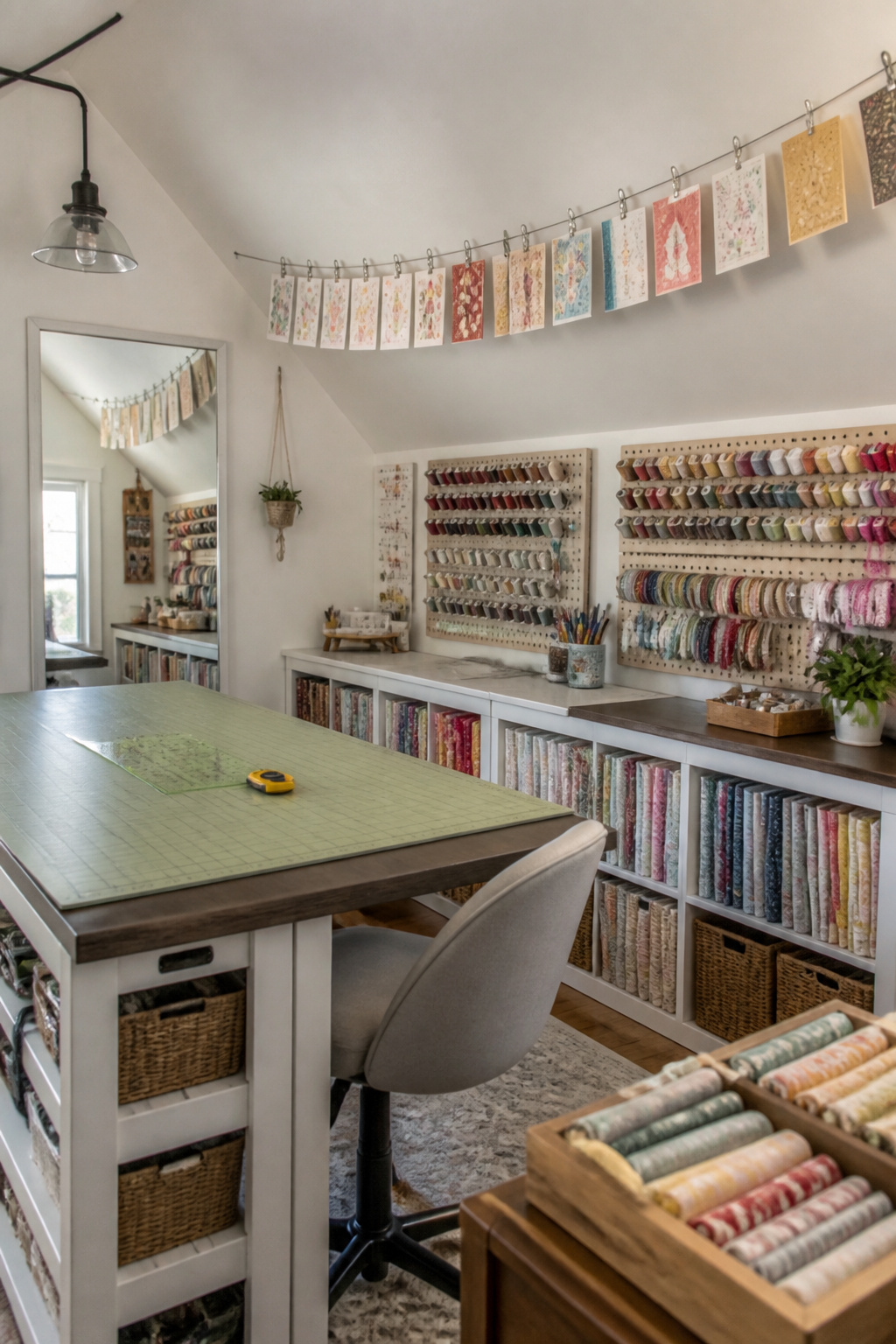
Sloped ceilings can read as a design feature instead of a problem if you treat the geometry as intentional. I painted the angled planes in my own attic sewing room a warm off-white one shade deeper than the vertical walls, which flattened the fold into a single gesture rather than chopping the room into triangles. The color wrapped the slope so the ceiling felt like a canopy, not a cavity.
For storage that earns its keep visually, I borrowed the bulldog-clip trick for pattern sheets: a galvanized steel cable stretched between two eye screws, clips hanging in a line that looks almost like bunting when the light hits it. Pegboard along the single vertical wall keeps thread racks and ribbon spools in sight, which matters more in an attic where every drawer means bending under a slope. The 14-by-16-foot footprint one sewer described is tight for a longarm, but she made it work by pushing functional storage into the knee walls and keeping the center open. That same logic applies to décor: the stuff you store can be the stuff you look at if you choose containers for their color and weight, not just their lid. Glass apothecary jars for buttons, wooden thread racks mounted flat against the one surface that stands upright, a three-tier cart in a tone that reads as furniture rather than utility.
The slope itself becomes a frame. I hung a single large mirror on the tallest vertical wall to push light up into the angle, and the reflection doubled the sense of headroom without costing any. What reads as cozy versus cramped is usually a lighting decision, not a square-footage one.
Recommended Products

【Fabric Organizing Boards Set】: You will receive 100 7.5 x 10.5 inch poster boards and 400 U-shaped transparent plastic alligator clips. This combination is great for organizing your fabric and keeping them straight and visible

Ample Quantity: Fabric organizer boards package includes 200 7.5*10.5 inches fabric storage boards, 400 u-shaped clear plastic alligator clips, easy to organize your fabrics, books, comic books neatly

Nice Additions to Your Fabric Storage Solution: you will receive 50 pieces of fabric boards for fabric storage and 200 pieces of clear plastic alligator clips, This quality storage solution enhances the look and feel of your workspace, suitable for organizing your fabrics
Built-In Storage for Sloped Ceilings
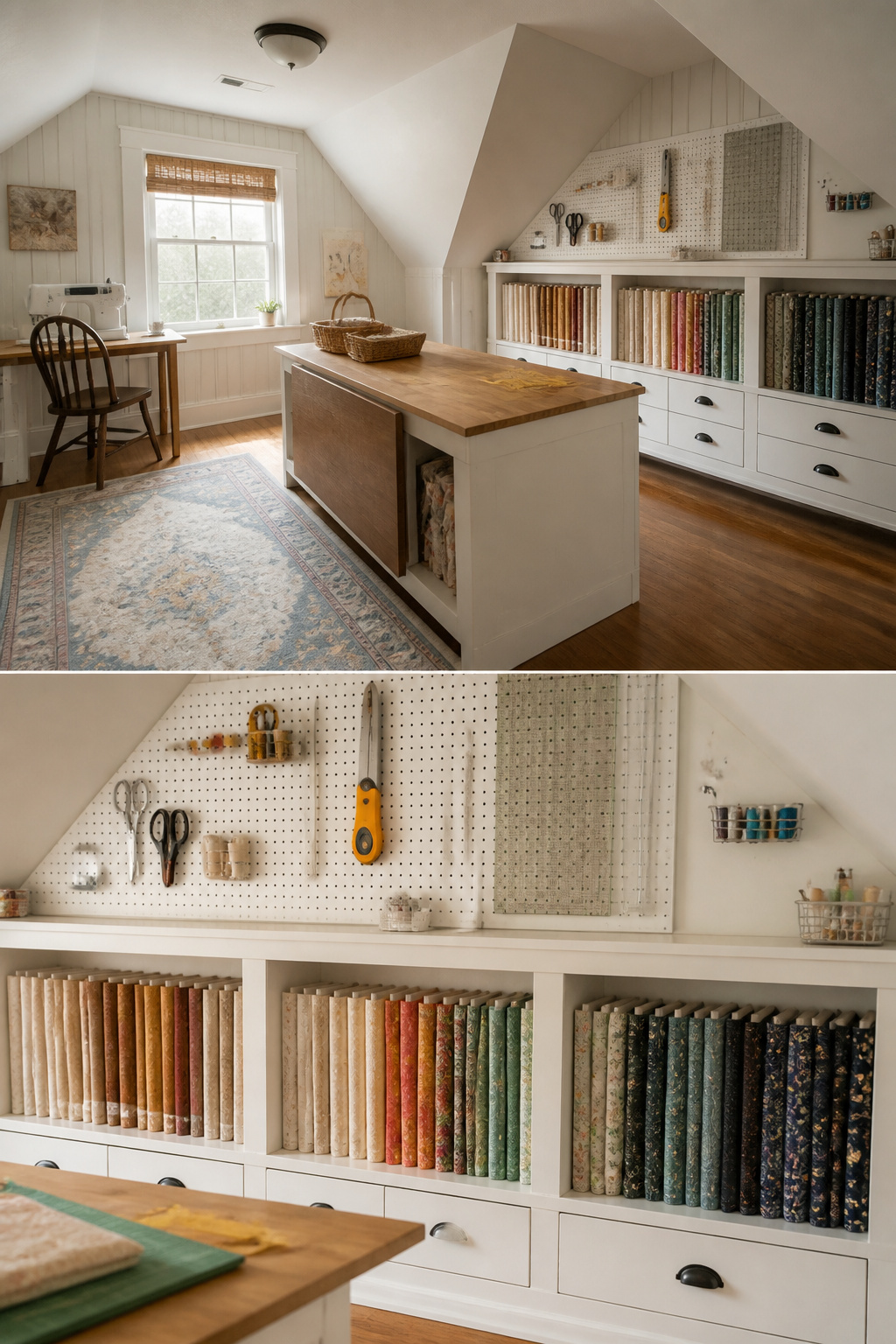
The knee wall in a typical attic runs about four feet before the roof line kicks in, and that triangular gap above it is dead space until you decide to claim it. One approach is to frame shallow cabinets into the slope itself, keeping the face flat while the backs follow the roof angle. This works for fabric bolts, pressing tools, and anything that tolerates a sloped lid. A pegboard strip framed at the top of that knee wall turns the remaining vertical surface into reachable storage for rulers, rotary cutters, and thread spools without sacrificing the cabinet depth below.
For the floor space directly under the sewing table, a fifteen-foot run with a hinged top buys back the area most tables waste. Store batting, shipping boxes, or seasonal projects there; the lift-up surface means you are not crawling underneath to retrieve anything. If you are building upstairs because the staircase is narrow, plan the table in sections that clear the stairwell, then hinge them together on site. The same logic applies to a fold-down extension on the table end: more work surface when you need it, flat against the wall when you do not.
Insulation boards from the hardware store, taped and wrapped in batting, make a design wall for the largest flat wall you can find. White tape matters more than you think; regular silver duct tape shows through light batting and the fix is permanent once it is mounted.
Recommended Products

Weatherproof Sealing Strips : Integrated weather seals prevent wind and rain ingress, ensuring a leak-proof seal for reliable protection against the elements Durable Aluminum...
Specific Tools Worth Naming

Pegboard reads well on Pinterest, but a sloped attic wall limits where it actually fits. The IKEA pegboard with clear containers and shelf gets mentioned repeatedly by people who have sewn in tight corners, and that smaller size is what works when a full wall is not available.
- Thread racks that mount to the back of a door survive the weekend-install test better than wall-mounted versions where the ceiling drops at knee height. Command hooks for rulers, suggested by someone working with two half walls and French doors, transfer straight to any attic door that opens into the room.
- Bobbin clamps stop thread from unwinding, though the color-matching fuss is real. Small ponytail holders, the soft fuzzy kind, do the same job without the visual clutter. Either beats rewinding a bobbin by hand mid-project.
- Cabinets for fabric storage matter more in an attic than in a ground-floor room because direct sunlight through those angled dormer windows will fade folded yardage. Store fabric and works-in-progress out of the light path, even if the cabinet itself is nothing special.
What I Got Wrong the First Time
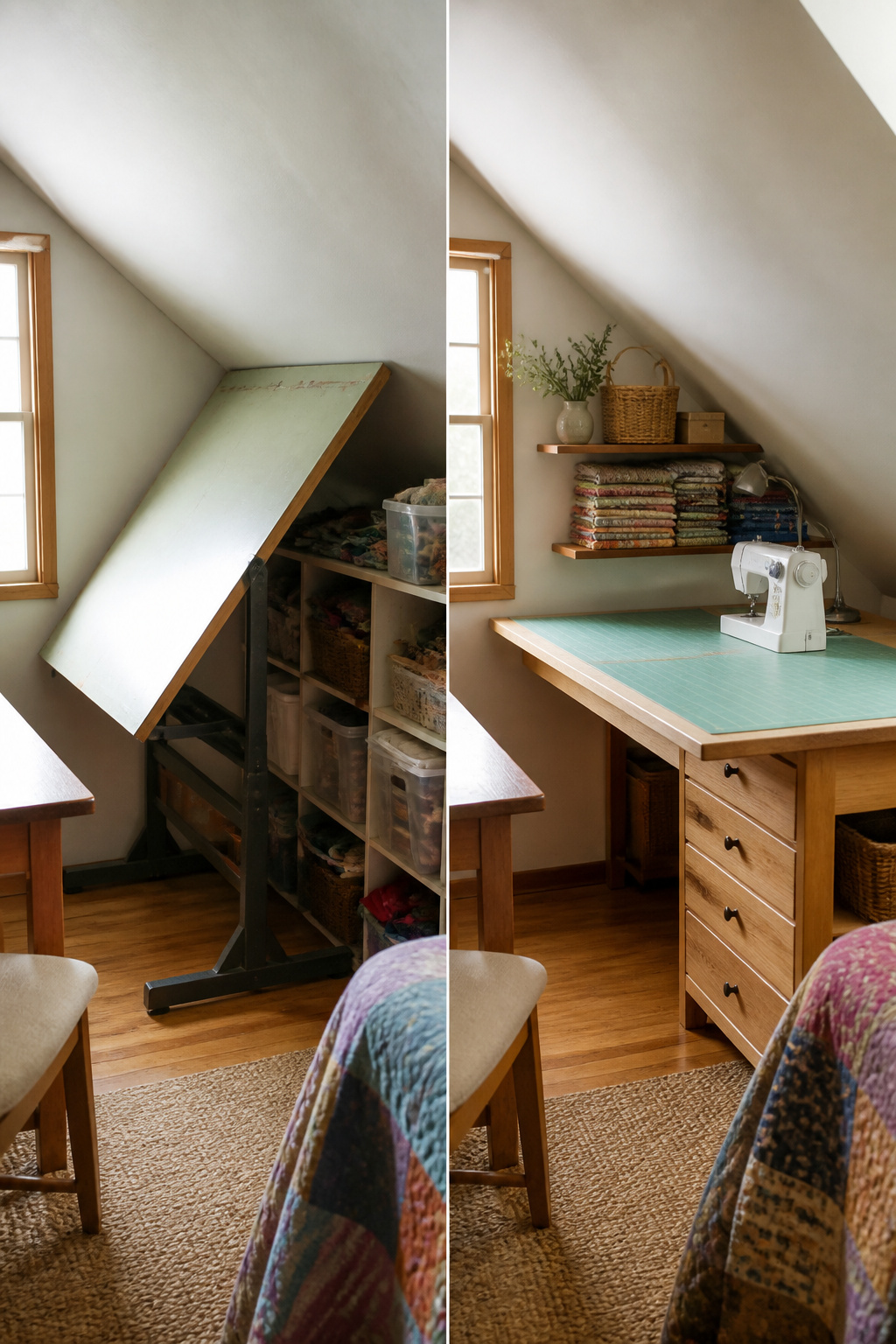
The first desk I hauled up to my attic sewing room was a vintage drafting table, solid oak, beautiful lines. I measured the floor space twice and never once checked the clearance at the knee wall. That sloped ceiling caught the back edge at 34 inches high, so the table tilted forward like a ship taking on water. I wedged it for three months before admitting the geometry had beaten me.
Storage that looks organized and storage you can actually use are two different projects. I installed a wall of shallow bins labeled by color, everything visible, everything Pinterest-worthy. What I failed to account for was reaching them. The sloped ceiling meant the upper rows sat behind a plane of angled drywall. To pull a half-yard of navy batik, I had to crouch, reach, and hope the bin didn’t tip. The system looked efficient in photographs and punished me every time I sewed.
Lighting was the slowest betrayal. August afternoons, the attic seemed bright enough with a single pendant and the window. By November, I was squinting at seam allowances at four in the afternoon, threading needles under a desk lamp that threw my own shadow directly across the fabric. The bulb was adequate; the placement and the season were not. I added a Daylight lamp the following spring, positioned to the left of the machine, and finally stopped losing hours to eye strain and bad guesses.
Recommended Products

45mm ergonomic rotary cutter - The TrueCut 45mm My Comfort Rotary Cutter has an ergonomic comfortable design that will help avoid wrist cramps while cutting your fabric.

The Creative Grids 45mm rotary cutter comes in a protective zippered case that includes plenty of room to store additional blades and notions.

UPRIGHT DISC ORGANIZATION — Keeps your cutting wheels, sanding discs, and grinding pads neatly stored in vertical slots. Each disc sits securely in its own channel, preventing chips and edge damage that come from tossing them loose in a drawer or bin.
Frequently Asked Questions
Recommended Products

【Universal Size & Multi-Room Organization】The standardized size of 11"x11"x11" seamlessly integrates with over 90% of cube organizer, from bedrooms to game rooms to laundry rooms, making it an ideal choice for storing books, toys, clothes, etc.

Sturdy&Durable: The 13x15x13in cube storage bins made of superior thick fabric and cardboard, with shiny metal handles. They’re super sturdy and not flimsy, perfect for the cubed bookcase, home organized, cloth, shelves, closet, office. This is what you’re looking for something elegant, stylish, and durable!

33x33x33cm/13x13x13inch Attention!!! This cube storage organizer bins is Black Wood Grain PRINTING instead of real wood grain.
What are some good storage solutions for an attic sewing room?
An IKEA Kallax 5×5 organizer sits flat against short knee walls and turns dead space into sixteen cubbies of usable storage, with the top surface doubling as a pressing station. Pegboard mounted on sloped ceiling areas keeps rulers, rotary cutters, and shears in arm’s reach without consuming counter space. For fabric inside those cubbies, wrap yardage around comic book boards so every piece stands upright at identical dimensions, which stops toppling stacks and buried prints.
How can I maximize natural light in an attic sewing room?
Position your machine table to face a dormer window directly, which gives you full daylight without sacrificing the floor area a vertical window would demand. Skylights above the work area scatter light more evenly across cutting surfaces. Either setup provides enough daylight to sew accurate seams and photograph finished work without a ring light, which is the difference between a room that functions and one that frustrates.
What furniture works best for a small attic sewing space?
A cutting table that doubles as storage is the single most useful piece, and 5 by 8 feet is the size that fits the largest rotary cutting mat without overhang while handling 60-inch fabric for single-layer cuts. Kitchen islands convert well; add casters so you can roll it to where ceiling height allows movement, then park it under the slope when floor space gets tight. A fifteen-foot run with a hinged top under the sewing table buys back wasted area for batting, shipping boxes, or seasonal projects.
What are effective organization tips for fabric and supplies in an attic sewing room?
Fold fabric to the height of a comic book board, wrap it around once, and store pieces vertically in cube organizers so every print stays visible. Label clear bins facing the sloped ceiling side, where your eyes actually go when you duck under a rafter. Hang tools on pegboard in the open air rather than drawers, since use returns them to place and sloped ceilings make every drawer mean bending under a rafter.
How can I decorate an attic sewing room with sloped ceilings?
Paint angled planes a warm off-white one shade deeper than vertical walls, which flattens the fold into a single gesture so the ceiling reads as a canopy instead of a cavity. Stretch galvanized steel cable between two eye screws and hang pattern sheets with bulldog clips in a line that looks like bunting when light hits it. A single large mirror on the tallest vertical wall pushes light up into the angle and doubles the sense of headroom without costing any square footage.