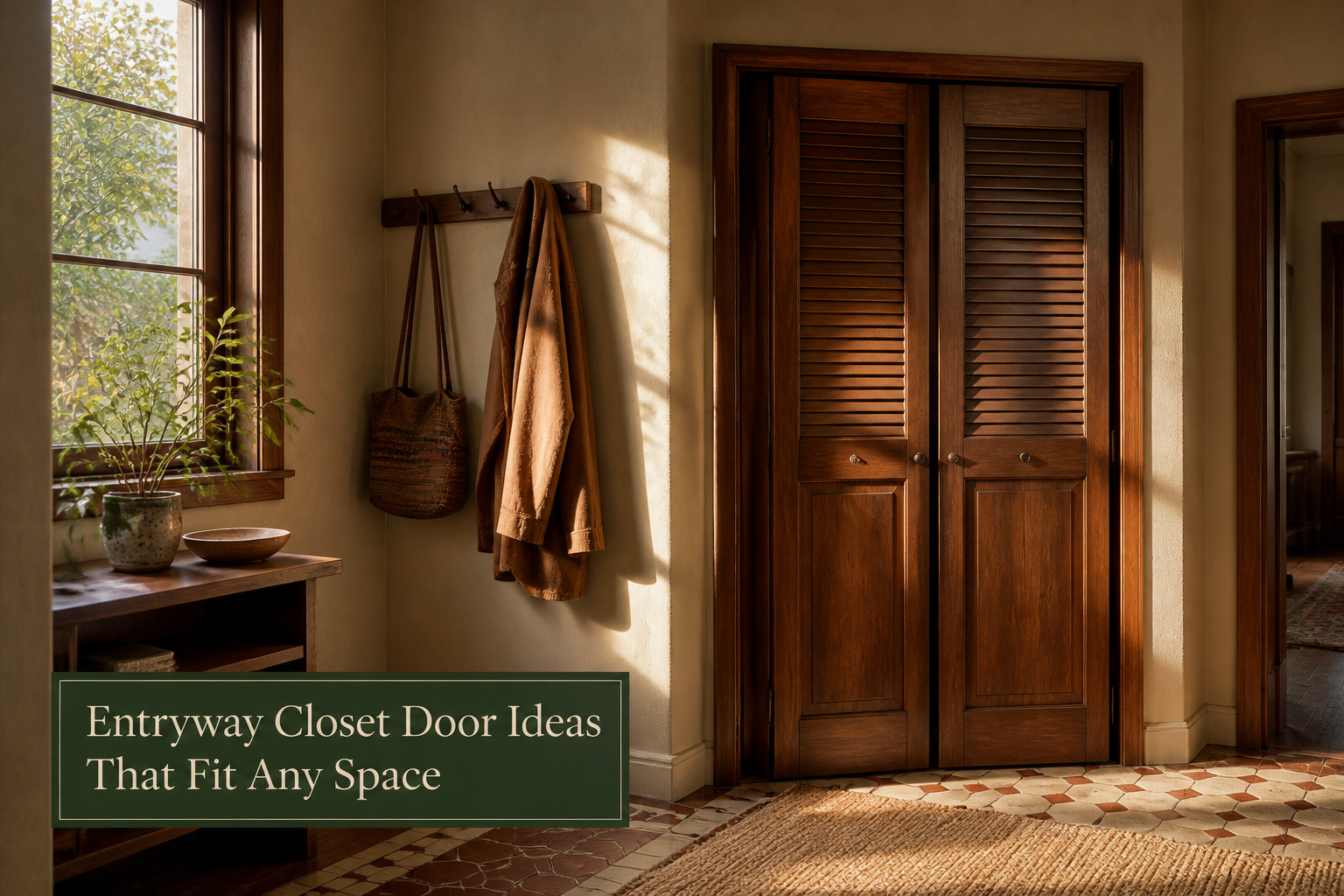
The right entryway closet door is the one that stops fighting your hallway for space. A standard swing door demands 24 to 36 inches of clear arc to open, which in a narrow corridor means blocking traffic every time you grab a coat. Bifold panels fold back to eat only six to eight inches of depth, sliding systems park beside the opening instead of into it, and pocket doors disappear entirely into the wall. The cost spread is just as wide: a hollow-core bifold set runs under a hundred dollars at any big-box store, while a full pocket-door install means opening the wall and reframing.
1. Bifold Doors

Bifold doors fold back on themselves in pairs, which means you do not need the swing clearance a standard hinged door demands. That alone makes them the default choice for entryways where every inch of hallway counts, and it is why they show up more often than any other option when you start reading through project write-ups.
The real advantage is how little they cost and how much you can still change about them. A basic six-panel hollow-core set runs well under a hundred dollars at any big-box store, and the same door can take paint, new pulls, or a cut-in louver kit without much trouble. I have seen renters swap the stock hardware for matte black levers in an afternoon and end up with something that looks built-in.
They work best when the closet opening is standard width and there is nothing you need to walk past while the doors are open. The folded panels do stack out about six to eight inches into the room, so a very narrow passage can still feel pinched. If your entryway is a tight galley, measure that stack depth against your walking line before you commit.
The hardware is the part that fails first, so spend the extra ten dollars on a decent track set. The cheap ones start grinding after a season of damp coats and boots.
Recommended Products

【Package Include】top bracket *2, bottom bracket *2, top guide wheel *2, top plastic pivot *2, bottom pivot *2, spring metal pivot pin *2, screws. Suit for 7/8" to 1" wide door track

Complete Range of Folding Door Hardware Repair Kit Parts: 2-Pack Bifold door hardware kit includes 2 top metal pivots, 2 top plastic pivots, 2 bottom pivots, 2 x 7/8" plastic guide wheels, 2 bottom pivot brackets, 2 top pivot brackets, 6 mounting fasteners, and 1 installation manual. Closet door hardware kits can quickly and easily repair doors weighing up to 50 lbs. and with thicknesses ranging from 1" to 1-3/8", suitable for 7/8"-1" wide track. (Please note: Track and hinges are not included.)

[Complete Kit for Hassle-Free Repair] - This comprehensive 12-piece bifold door hardware kit includes everything needed to fix wobbly, stuck, or noisy bifold doors: 2 top brackets, 2 bottom brackets, 2 top guide wheels, 2 top plastic pivots, 2 bottom pivots pins, 2 spring-loaded metal pivot pins, and mounting screws. Parts in standard sizes, premium materials, and robust structure ensure quick restoration of bifold doors with 2 or 4 panels of 7/8" to 1-3/8" thick, weighing up to 30 lbs/panel and fitting 1" wide tracks.
2. Sliding Doors

Sliding doors earn their keep in narrow entryways for one simple reason: they never swing into the hallway. A hinged door needs a clear arc of floor space to open, and in a tight corridor that means the door hits whoever is walking past or blocks the path entirely. Sliding panels run on a track instead, one tucking behind the other so the closet stays accessible without stealing an inch from the walkway.
The material choices run wider than most people expect. Solid wood gives a warm, finished look that matches interior doors elsewhere in the house. Mirrored panels bounce light around a dim entry and make the space feel larger than it is, which matters when the closet sits right at the front door. Glass keeps things lighter still, though it works best when the closet behind stays reasonably tidy. The track itself sits on top of the frame, so the doors glide regardless of whether the floor is hardwood, tile, or carpet.
In one narrow hallway, swapping a swing door for sliding doors fixed what the owner called the "door hits you" problem instantly. That is the move here: gain usable floor space without touching the closet box inside. For a weekend project with a few hundred dollars, this is the most reliable way to stop fighting your entryway every time you come home with groceries.
Recommended Products
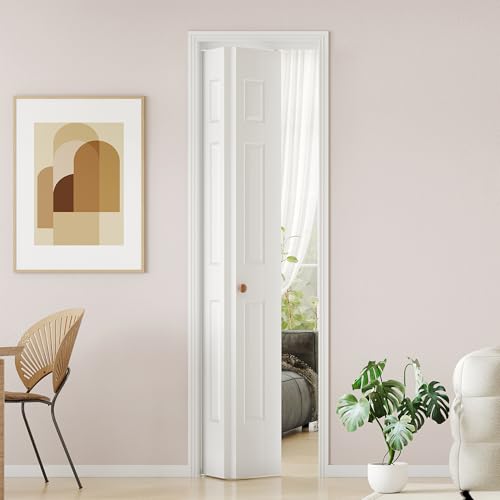
Lightweight Hollow Core Construction: Our bifold barn door is engineered with a durable hollow core design. This lightweight build ensures effortless, quiet folding action, reducing long-term stress on the hinges and track. The door comes finished white primer, you can easily paint or stain it in any color of your choice to complement your home's style.

Our bi fold door crafted with durable hardboard and hollow core construction, not only sturdy and durable, but also lightweight.

Lightweight Hollow Core Construction: Our bifold barn door is engineered with a durable hollow core design. This lightweight build ensures effortless, quiet folding action, reducing long-term stress on the hinges and track. The door comes finished white primer, you can easily paint or stain it in any color of your choice to complement your home's style.
3. Barn Doors

Barn doors hang on exposed hardware that becomes part of the look itself, not something to hide. That hardware is the style: matte black rails read industrial, antique brass leans traditional, and polished nickel fits somewhere more refined. The door panel can follow the same direction or push against it. A high-gloss black slab with elegant brass hardware steers clear of farmhouse territory entirely, which is the pairing a Toronto designer used to modernize a converted factory bedroom.
The mounting is what matters for an entryway. The rail fastens to the wall outside the door frame, so the door slides parallel to the wall rather than swinging into the room. That setup steals wall space you cannot use for hooks or art, but it saves the floor space a swing radius would eat. In a narrow hallway where every square foot counts, the trade usually favors the barn door. You lose the wall, but you keep the walkway clear.
"A barn door is a great option so that a typical door swing does not become a space issue in a small room."
For renters, this is a judgment call. The rail needs solid blocking or studs to hold the weight, and the holes stay when you leave. If your lease allows it and you have the wall to spare, the floor plan relief is immediate. If the hallway is already tight on wall space for coats and keys, a bypass or bifold system keeps more surface free.
Recommended Products

Made for RV Wardrobes: pair of door latches designed to hold mirrored sliding closet doors securely closed while your motorhome or trailer is in motion

New Look: Enhance the appearance of your home by adding sliding mirrored doors from SOLRIG to your bedroom closets. Mirror doors not only provide a clear reflection but also elevate the overall aesthetic of your space. With their elegant design, they offer both practicality and style, allowing you to stack them to the right, left, or even in the center.

Full-Length Mirror Panel Boosts Light & Visual Space: Actual closet door panel size: 2 panels of 30.98" W x 78.58" H x 0.98" T, fits 60" x 80" door openings. This sliding closet door features full-height mirrored panels paired with a continuous mirrored header, forming a seamless reflective surface. It reflects natural light and visually enlarges your room, bringing brighter, roomier feeling to bedrooms, walk-in closets and pantries.
4. French Doors

Paneled glass centers are the defining detail of French doors, and in a closet that means the interior stays visible around the clock. That exposure can read as elegant display if your shelves stay tidy, or as daily clutter if they do not. Fitted shades or a simple curtain rod inside the frame solve the second problem without killing the look.
The elegance lands best in traditional or transitional homes where the door casing already has some weight to it. In a tight hallway, the glass panels borrow light from adjacent rooms and turn the closet into a small architectural moment rather than a blank slab. Brass or gold-finished lever handles finish the effect without extra ornament.
What convinced me, reading through the options, is that French doors are one of the few closet upgrades that interior designers currently cite by name. The pair I keep returning to is airy, glass-paneled double doors with pantry-style proportions: they let light flow through the entry while the grid pattern adds enough structure to feel intentional. If your closet interior tends toward chaos, budget for the shade hardware before you order the doors.
Recommended Products

DOOR BOTTOM GUIDE – This sliding door floor guide helps keep by-passing sliding door panels centered on their respective tracks

Used for a wide variety of different closet door manufacturers

[SLIDING BYPASS DOOR GUIDE] - Easy to install bracket helps keep sliding doors in place and centered on their tracks
5. Glass Doors

Glass closet doors in an entryway live or die on what you can see through them. Clear panels turn your coat pile into a daily exhibit; frosted glass keeps the light moving through while the mess stays invisible. That trade matters more here than in a bedroom closet, because the entryway is the first thing anyone sees.
The frosting itself comes in degrees. A matte finish with high transparency still hints at shapes behind it, while a rougher texture blocks almost everything. Plastic frosting film or spray paint can convert an existing clear door without a full replacement, which keeps the project inside a weekend and a tight budget. For something more distinct, antique textured glass or white slag glass gives the same privacy with more character than a factory frosted panel.
Premade options run from smooth to rough, gloss to matte. The one constant is that frosted glass still reads as open space to the eye, even when it hides the contents completely. In a narrow apartment hallway, that borrowed light can matter more than any hardware choice.
Recommended Products

Precision Limit & Anti-Collision: Adopts pulley technology to precisely control door travel, effectively preventing violent impact between the door and frame/wall at the source, and protecting both hardware and walls.

COMMERCIAL GRADE POCKET DOOR HARDWARE – Designed specifically for interior sliding pocket doors, this aluminum track system provides a stable and durable solution for smooth single-door installations

Clear Size Compatibility: This pocket door track kit fits common interior door sizes. Featuring a 44.69 in (1135 mm) track, it fits 24 in (610 mm) wide doors with thicknesses from 1 to 1-3/4 in (25–45 mm). Ideal for bedrooms, closets, and storage rooms
6. Louvered Doors

Louvered doors let air move through an entryway closet in a way flat panels simply cannot. The angled slats, set like shutters, create passive ventilation that keeps damp outerwear and shoes from turning musty in a confined space. In a stuffy apartment hallway, that airflow can mean the difference between towels that stay fresh and ones that sour.
The texture those slats add is the other half of their appeal. A wall of flat doors reads like a plain box; louvered ones break up the surface and catch light differently throughout the day. They come bifold, hinged, or in other configurations, so the look adapts to the opening you have rather than forcing one standard shape.
The tradeoff is dust. Those same gaps that move air let fine particles through more readily than a sealed panel. For a closet holding daily-use coats and boots, the ventilation usually wins. For stored linens or out-of-season clothes you touch rarely, a tighter door might be the smarter call.
Recommended Products

Make Repairs Easier: Stop worrying about broken folding door hardware! CRANACH bi-folding door repair parts have correctly classified the hardware problems of the entire bi-folding door, providing a variety of parts in standard sizes, safe materials, and durability. Detailed installation instructions are included with each package, which is easy to operate and replace parts. Bi-fold barn door hardware set saves money and gives you a sense of accomplishment in repairing doors or furniture.

COMPLETE FOLDING DOOR HARDWARE KIT: Professional bifold door hardware set includes steel track and all mounting components for 36 in doors, supporting up to 30 lbs per door with four-way adjustability for perfect alignment and smooth operation

【Important!!!】Our 36-inch track is made up of 3 pack 12-inch tracks ; Package include 3 pack 12 inch track, not whole 36 inch track. Therefore, our bifold door hardware with track can fit for 24 inch (made up of 2 pack 12 inch track) or 36 inch (made up of 3 pack 12 inch track) door width. Use the connectors to connect the tracks. (2 pack connectors included)
7. Pocket Doors

A pocket door retreats completely into the wall cavity, which makes it the only option that leaves a tight entryway corridor entirely clear. The door slab travels on an overhead track and disappears between the studs, so there is no swing arc to dodge and no exposed hardware on the face of the wall. In a hallway where even a sliding barn door would feel like an obstacle, this is the cleanest solution I have seen recommended for closet concealment.
The catch is the framing. You need a wall thick enough to house the full door width plus the track mechanism, which rules out most retrofits in older homes with thin partition walls. Standard 2×4 framing with drywall can handle a typical 24- to 32-inch closet door; anything wider or any wall with plumbing or electrical in the path becomes a demolition project, not a weekend one. Pocket doors also demand precise installation, the track must be perfectly level or the door will drift open on its own. For a new build or a gut renovation, the tradeoff is worth it. For a quick update to an existing entryway, a surface-mounted sliding system is usually the more honest choice.
Recommended Products

Lightweight Hollow Core Construction: Our bifold barn door is engineered with a durable hollow core design. This lightweight build ensures effortless, quiet folding action, reducing long-term stress on the hinges and track. The door comes finished Black primer, you can easily paint or stain it in any color of your choice to complement your home's style.

【Premium MDF Construction & Primed】This bifold door is crafted from high-quality MDF engineered wood, offering a smooth, consistent surface that resists warping and cracking. The hollow core design ensures lightweight handling without sacrificing durability. For a custom look, simply use sandpaper (machine sanding recommended for best results) to prep the surface, then apply any latex or oil-based paint.
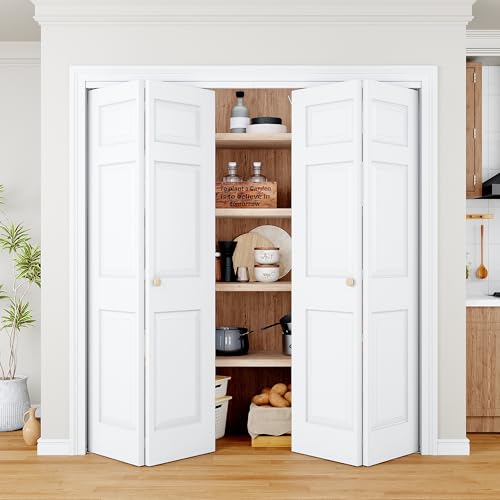
【Premium MDF Construction & Primed】This bifold door is crafted from high-quality MDF engineered wood, offering a smooth, consistent surface that resists warping and cracking. The hollow core design ensures lightweight handling without sacrificing durability. For a custom look, simply use sandpaper (machine sanding recommended for best results) to prep the surface, then apply any latex or oil-based paint.
8. Mirrored Doors

A full-length mirror at the exit point does two jobs at once: it bounces whatever daylight the hallway gets, and it gives you that last check before you leave. In a narrow entry, mirrored panels visually double the space without the floor-to-ceiling look that still reads 1980s to some eyes. Breaking the reflection into panels softens the effect and keeps the door from dominating the wall.
The weight is real. Mirrored doors run heavy, and the track hardware wears faster than standard sliding or bi-fold setups. Sturdy kits exist for this, but plan on checking the rollers more often than you would with hollow-core doors. If the full mirror feels like too much, overlay panels attach with clear adhesive and let you keep some reflective surface while updating the look. New pulls in brass or another warm metal finish the job without a full replacement.
One caution the sources flag: amplified reflections can disrupt sleep if the entry sits near a bedroom. For renters or anyone mid-project, the panel route gives you the brightness without the hotel-mirror effect.
Recommended Products
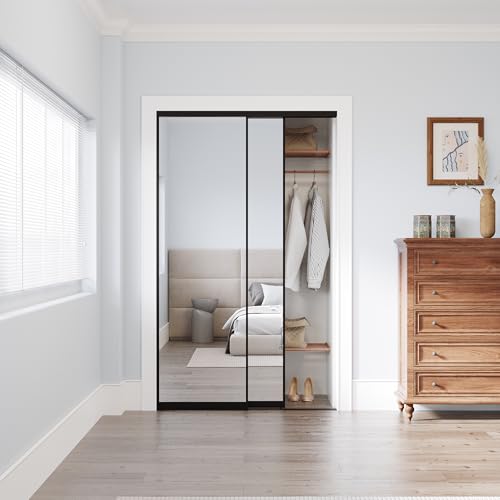
【Upgrade Mirror】 Our mirror surface covered with explosion-proof film, not easy to break, providing HD imaging while effectively protecting your safety and giving you a comfortable experience.

Elevate Your Home Decor: Upgrade your home with SOLRIG's mirrored bifold closet doors for your bedroom closets. These mirror bifold doors not only provide a full-length reflection but also create a spacious and bright ambiance in any room. Their versatile design allows you to flexibility stack them on the right, left, or center.

Outstanding Design: If you are hesitant about using up valuable floor space with a standing mirror, you can upgrade your interior design and add needed function with attractive and efficient Sliding Closet Door from SOLRIG.
9. Accordion Doors

Accordion doors fold back on themselves in a tight zigzag, which means you can open a hallway closet without the door ever swinging into the walkway. In an older rental with barely two feet of clearance, that geometry matters more than any hardware upgrade. The vinyl or lightweight wood construction keeps the cost low and the install simple; most units hang from a single top track with no bottom guide to wrestle into level.
The tradeoff shows up after about a year of daily use. The folded panels flex at their hinges every time someone passes through, and in a high-traffic entryway that motion adds up. The material is not built for the kind of grabbing and shoving that happens when you’re running late and need shoes in one hand. For a closet you open twice a day, the accordion works fine. For the main coat closet that sees six family members every morning, the lifespan shortens enough that I’d rather spend the extra Saturday on a sliding track.
Recommended Products

Roller assemblies for use with top hung, by-passing sliding wardrobe doors

[Heavy Duty Barn Door Hardware Kit]: Barn door track is made of high quality Aluminium alloy material, is more sturdy and durable. The nylon roller has undergone 100,000 tests and slides smoothly and quietly. (DOOR NOT INCLUDED.)

Comprehensive Package: this package comes fully equipped with essential components for instant application; The package includes 4 pieces of dial adjust door hangers in 2 types, 2 pieces for #1 and 2 pieces for #2, together with 8 pieces of screws, making the setup process hassle free and straightforward
10. Curtains

A tension rod and a pair of panels can turn a closet opening into something that looks intentional in about twenty minutes. That speed matters when you are renting and cannot drill into the frame, or when you want to test a look before committing to hardware. The rod sits inside the jamb, no brackets needed, and the whole setup lifts out when you move.
Fabric weight is where this either works or looks like a dorm-room fix. Thick linen-look panels with a fringed bottom hide the clutter behind them and add the texture that makes the doorway read as finished, not temporary. Thin sheers defeat the purpose; you want enough opacity that shoes and coats disappear.
A black industrial rod with clip-on rings upgrades the feel without adding cost or permanence. The clips let the fabric slide smoothly, and the dark metal gives the light fabric something to push against visually. When you tire of the color or the pattern, you swap the panels, not the rod. That flexibility is the real advantage: one weekend it is charcoal gray for warmth, the next it is floral if you want the closet to feel like a handmade armoire. No hinges, no track, no patching holes later.
Recommended Products

Superior High Quality: The pocket door frame kit includes strong complete galvanized steel track, durable steel reinforced wood studs, two-way soft-close mechanism and super smooth hanger, giving you high quality assurance.

SMOOTH QUIET SOFT CLOSE POCKET DOOR KIT: Single buffer + spring adsorption system delivers whisper-quiet soft close and soft open. Eliminates rattling, sticking, and slamming for a smooth, silent door experience in any room
11. Beadboard Doors

Beadboard brings vertical plank texture that reads instantly as cottage warmth, especially in a farmhouse entryway where every surface can feel a little too smooth. The ridges catch morning light and hide the scuffs that collect near a front door, which is why I keep coming back to it for high-traffic closets.
Beadboard can be applied straight over an existing flat door, so the upgrade does not require replacing the slab. You glue and nail thin beadboard panels to the face, trim the edges with molding to hide the seam, and paint everything in one go. A warm brown satin finish keeps the look timeless rather than trendy, and the texture does the visual work so the hardware can stay simple. A matte black lever against white millwork is enough contrast without competing.
Paintable beadboard wallpaper exists for renters or anyone who wants the texture without the power tools. It peels off later, and from a few feet back the effect is nearly identical.
12. Painted Doors

Paint is the cheapest way to turn an entryway closet door from afterthought into accent. A single bold color, something like the bright blue Dekay and Tate Interiors used on a West Palm Beach bedroom suite, can carry that hue from the closet across the bathroom door and the room entrance so the hallway reads as intentional rather than leftover space. The cost is a quart of paint and an afternoon; the impact is immediate.
High-gloss or semi-gloss formulas hold up better on a door people touch daily, especially around a hallway closet that sees traffic every morning and evening. Flat paint will mark and scuff within weeks in that spot. Satin is the compromise if you want some sheen without the mirror finish.
Patterns go further still. Chalkboard paint turns the door into a working surface for grocery lists and reminders, which matters when your entry is also your drop zone. A hand-painted arch-and-vines mural, simple enough to execute with painter’s tape and patience, reads as custom millwork to guests who do not know it was DIY. The other route is to spray the door the same color as the surrounding walls and trim, which interior designer Sacks used with louvered doors in a child’s bedroom to make an inexpensive choice look built-in and higher-end. Either approach works; the mural wins if you want the door to pull focus, the match if you want it to disappear.
13. Antique and Reclaimed Doors

Reclaimed wood doors carry a history that factory-fresh panels simply cannot replicate. Interior designer Daley sourced a set at an antique supplier in Arizona for a primary bathroom project, choosing a deliberately different design than the rest of the home so the doors would stand out against white walls and marble floors. That contrast, old material against new surroundings, is what gives the idea its power in an entryway closet.
The practical hurdle is sizing. Old doors rarely fit modern framing without modification, since standard closet openings today follow dimensions that did not exist when the original door was built. You will need to plane, shim, or reframe, and sometimes all three. The work is manageable for anyone comfortable with a weekend of measuring twice, but it is work you should budget for before you fall in love with a particular piece.
If the door is too short or too narrow for your opening, consider mounting it as a sliding barn-style installation rather than a hinged swing. That setup forgives more sins in width, though it adds the cost of track hardware. Either way, the door becomes the story your guests notice first.
Space Considerations by Hallway Width

Swing doors eat floor space in a way the hallway itself decides for you. The arc needs 24 to 36 inches of clear sweep, which in a 36-inch-wide corridor leaves you hugging the wall every time you grab a coat. I learned to measure twice after installing a pair that opened beautifully into the closet and immediately blocked the hall.
Sliding and barn doors trade that arc for wall length; the door panels park beside the opening, not in it. Pocket doors go further and demand wall depth instead, swallowing the panel whole into the framing. The cleanest look in a skinny corridor, though the upfront work is heavier. Curtains skip every structural requirement entirely, hanging on a rod with zero clearance needed and zero hardware in the floor or wall cavity.
| Door type | What the space must give | Best fit |
|---|---|---|
| Swing | 24–36 in. floor arc | Wide hall, 48 in. plus |
| Sliding / barn | Wall length ≥ door width | Narrow hall with adjacent wall |
| Wall depth for cavity | Tightest corridors; new build or remodel | |
| Curtain | Rod depth only | Renter, tightest budget, temporary fix |
Material and Hardware Pairings

Wood expands and contracts with every season change in an entry, so solid-panel doors need a gap you can live with or a frame that hides it. Glass behaves more steadily but shows fingerprints within a day of real traffic, and metal tracks or frames can sweat in cold weather, which matters if your closet sits against an exterior wall.
A long pull beats a small knob when your hands are full of bags or keys. The difference is one you feel daily. Integrated pulls, routed into the door edge and painted to match, skip the hardware entirely and read as cleaner against adjacent interior doors. Brass or silver hardware works, yet the inset option keeps a modern slab from looking like an afterthought.
Sliding systems run on a track that does not care about your flooring type, which is worth remembering if you are switching from carpet to LVP and want the door to survive the change. Hinged doors let you match existing interior hardware for cohesion, or deliberately mismatch to make the closet a point of interest. Either way, the material and the handle choice should answer the same question: what happens when someone enters with wet shoes in January and full hands in July?
DIY Updates That Take a Weekend

Flat doors are the easiest starting point. A quart of paint and a Saturday morning will cover a standard 80-by-30-inch slab in two coats, and satin or semi-gloss holds up to the hands that grab it daily. I have seen a warm brown satin finish turn a plain hallway door into something that looks built for the house, not tacked onto it.
If the door has more surface than interest, peel-and-stick molding tape builds fake panels without a saw. Miter shears handle the corner angles, and construction adhesive anchors the trim. The whole job stays quiet enough for an apartment building at 9 a.m.
Beadboard needs a little more time, maybe a full weekend. You glue it straight onto the existing door face, paint to match or contrast, and the texture does the rest of the work. This one shines on doors that already feel flimsy; the extra layer adds weight and the eye reads it as custom.
Peel-and-stick wallpaper is the fastest renter move. One flat afternoon, no landlord drama, and the pattern comes down when your taste shifts. It works best on truly flat panels; trim or hardware edges make the seams fight you.
What to Avoid in Entryway Closets

Every entryway closet door choice runs into the same wall: the thing that looks good in a photo works against you at 7 a.m. when you’re rushing out with coffee in one hand. The sources I read kept circling back to three specific mismatches.
- Clear glass panels expose everything. One homeowner swapped to frosted glass after realizing she could see every coat, bag, and vacuum through her hallway closet doors. Frosted film or spray paint fixes existing doors; replacement frosted doors come in smooth or rough textures with matte or gloss finishes. The frosted effect keeps light moving while blocking the view inside.
- Oversized hardware catches sleeves and straps. A barn door track or chunky handle that looks minimal in a wide shot becomes a hook for your coat the second you pass it with an armful of groceries.
- Doors that swing into narrow entryways block traffic. A standard hinged door needs roughly 30 inches of arc; in a tight apartment entry, that arc is where you stand to put shoes on. Sliding or pocket hardware solves this, but only if the wall depth exists. Measure the wall cavity before you fall for a style that needs space you don’t have.
Frequently Asked Questions
What can I use instead of folding closet doors?
Sliding doors, pocket doors, and barn doors are the most common swaps when you want to lose the fold. Each trades the bifold stack for something that stays out of the walkway: sliding panels tuck behind each other, pocket doors disappear into the wall entirely, and barn doors glide along the outside wall. Curtains on a tension rod work too if you need a zero-hardware fix.
What’s in style for closet doors?
French doors with paneled glass, bypass sliding systems, and doors dressed up with paint or wallpaper are all current. Designers right now name French doors specifically for the way they borrow light and turn a closet into an architectural moment. Bold paint colors and beadboard overlays also rank high for giving flat slabs a custom look without a full replacement.
How should I decide on closet doors?
Start with your hallway width and daily traffic pattern, then match the door type to what the space can give. A swing door needs 24 to 36 inches of clear floor arc; sliding or barn doors need wall length instead; pocket doors need cavity depth inside the framing. Once the geometry is settled, pick the material and finish that fits how hard the door will work at 7 a.m. with wet shoes and full hands.